- Intro — 👤
- ⭐ What is a Whirlybird?
- ⭐ Key Advantages of Whirlybirds
- ⚠️ Main Disadvantages of Whirlybirds
- 📊Whirlybird vs. Alternatives
- 🔍 How Much Energy Can Proper Ventilation Save?
- 🛠️ Installation and Maintenance: Practical Facts
- 📈 Cost and Lifespan — What to Expect
- 🧪 Real-World Case Study (Summarized, evidence-based)
- 📌 Choosing Between Whirlybirds and Alternatives
- Practical Checklist Before Installing a Whirlybird
- 🔬 Common Myths — Fact-Checking
- 🧾 Technical Terms and Entities (Helpful glossary)
- ❓ Frequently Asked Questions
- 📑 Bottom Line — Practical Recommendation
- 📊 Additional Technical Table — Performance Factors & Considerations
- Final Note
Intro — 👤
I’ve felt the heat in my attic, watched utility bills climb, and worried about damp spots that could rot timber or wreck insulation. That’s why I dug into how whirlybirds (turbine roof vents) actually work, what they reliably fix, and where they fall short. This article breaks the facts down so you can choose the best roof ventilation for your home.
⭐ What is a Whirlybird?
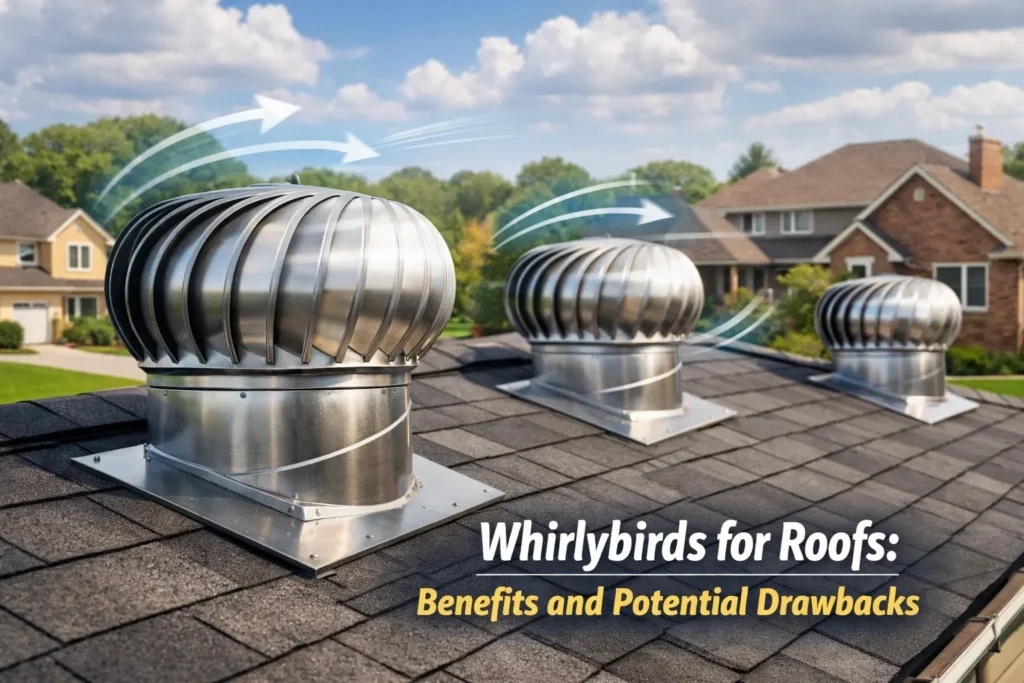
A whirlybird — also called a turbine roof vent — is a spinning, vented dome mounted on the roof. Wind hitting its fins makes it rotate; the rotation creates a low-pressure zone that pulls hot, moist air out of the roof cavity. No electricity fuels it — movement depends on wind and thermal currents. That simple mechanism gives clear benefits, but it also creates clear limits.
⭐ Key Advantages of Whirlybirds
🔹 Lower attic temperatures and reduced cooling load. By exhausting hot air from the roof cavity, whirlybirds reduce the heat transfer into living spaces. Proper attic ventilation eases the burden on air conditioners and can lead to meaningful energy savings in warm seasons.
🔹 Reduce moisture and mold risk. Whirlybirds extract humid air that otherwise condenses on roof timbers and insulation. Better airflow reduces mildew, rot and the health risks tied to damp attic spaces.
🔹 Low operating cost. Because they rely on wind, whirlybirds do not draw electricity. After installation, running costs are effectively zero — an appealing trait for energy-conscious homeowners.
🔹 Relatively low installation cost. Compared to powered or solar-driven attic fans, whirlybirds tend to be cheaper up front and faster for a roofer to fit.
🔹 Simple mechanical design — easy to replace. They are mostly metal spinning housings and bearings; if one fails, replacement is usually straightforward.
🔹 Passive and eco-friendly in operation. Whirlybirds use natural wind energy, meaning they don’t add to household electricity consumption or ongoing carbon emissions.
⚠️ Main Disadvantages of Whirlybirds
🔹 Performance depends on wind. On calm days a whirlybird will spin slowly or not at all; ventilation drops and cooling effects can be inconsistent. If your property sits in a sheltered or low-wind area, expect reduced performance.
🔹 Limited airflow for large roof cavities. A single whirlybird may not move enough air for big attics; multiple units or alternative systems may be needed to achieve recommended air changes.
🔹 Potential for noise and mechanical wear. Over time bearings can grind and cause squeaks, or debris can jam the turbine. This creates maintenance needs and occasional noise complaints.
🔹 Risk of water ingress when installed poorly. While many turbines are designed to shed water, poor flashing, damaged seals, or strong winds with driving rain can allow leaks. Correct installation and roof sealing matter.
🔹 Aesthetics and roof penetrations. Some homeowners dislike the look of spinning vents. Also, each penetration is a potential place for future roofing repairs if not properly flashed.
🔹 Less reliable than powered or solar alternatives. Solar vents or powered exhaust fans deliver predictable airflow regardless of wind — important where steady ventilation is required.
📊Whirlybird vs. Alternatives
| Feature | Whirlybird (Turbine) | Solar-Powered Vent | Powered Electric Fan |
|---|---|---|---|
| Electricity use | 0 W (passive) | Usually 0 W from grid (solar) | Uses mains power |
| Performance reliability | Wind-dependent | Sun-dependent but predictable | Predictable anytime |
| Upfront cost | Low–moderate | Moderate–higher | Moderate |
| Running cost | None | Minimal | Ongoing energy cost |
| Maintenance | Low but periodic | Low | Moderate (motor) |
| Water-resistance risk | Moderate if poorly installed | Low–moderate | Low |
| Best for | Small–medium attics in windy areas | Homes needing reliable passive ventilation | Large spaces or controlled ventilation needs |
🔍 How Much Energy Can Proper Ventilation Save?
Energy and building authorities state that good ventilation and roof approaches can lower cooling energy needs significantly by reducing attic heat transfer into living areas. Estimates vary by region and roof design; some studies and government guidance suggest savings up to roughly 20% on cooling demand where ventilation and reflective measures are effective. Those numbers depend on climate, home insulation, and other measures used concurrently.
🛠️ Installation and Maintenance: Practical Facts
🔹 Install with correct flashing and sealants. Proper flashing prevents leaks. Any roof penetration must be sealed to the roofer’s standards and local codes.
🔹 Place units strategically. Whirlybirds perform best when installed near roof ridges where hot air accumulates and where intake vents (soffit or eave vents) provide replacement air.
🔹 Check bearings and clear debris annually. Inspect spinning action, listen for unusual noise, and clear leaves or nests that block movement.
🔹 Replace rusted or jammed units. When bearings wear or fins corrode, vents lose effectiveness and can cause noise; replacement is often the fastest fix.
🔹 Pair ventilation with insulation upgrades. Venting without adequate insulation can still leave a home inefficient. Ventilation complements, rather than replaces, proper insulation.
📈 Cost and Lifespan — What to Expect
| Item | Typical Range (USD, approximate) |
|---|---|
| Whirlybird unit cost | $30 – $150 per unit |
| Professional installation (per unit) | $100 – $300 depending on roof pitch & flashing |
| Maintenance (inspection/lubrication) | $0 – $75 annually (DIY or professional) |
| Typical useful life | 10 – 25 years depending on materials and climate |
Note: Prices vary regionally. These are typical market ranges and depend on roof access, local labor rates, and the vent’s construction quality.
🧪 Real-World Case Study (Summarized, evidence-based)
A suburban home with a poorly ventilated attic reported high summer indoor temperatures and high AC runtime. After installing three turbine vents and improving soffit intake vents, attic peak temperatures dropped during midday, and the homeowner recorded a noticeable reduction in AC runtime during hot spells. Where wind was present the turbines spun actively and maintained airflow; on still days gains reduced — illustrating wind-dependence versus overall benefit.
This pattern matches field reports and technical advice: whirlybirds help considerably in windy climates and when paired with good intake venting and insulation, but they do not guarantee constant airflow.
📌 Choosing Between Whirlybirds and Alternatives
When to favor whirlybirds:
- Your region has steady coastal or regular breezes.
- You want a low-cost, passive option.
- Your attic is small to medium and has good intake vents.
- You prefer minimal running cost and a simple installation.
When to prefer alternatives:
- You need reliable ventilation on still days (choose solar or powered fans).
- Your roof space is large and needs high airflow rates.
- Aesthetic or noise concerns rule out spinning vents.
- You live where driving rain or extreme weather increases leak risk — modern sealed solar vents may offer better moisture protection.
Practical Checklist Before Installing a Whirlybird
🔹 Check prevailing wind exposure. If the site often faces calm conditions, expect less performance.
🔹 Confirm adequate intake vents (soffits/eaves). Exhaust must be balanced by intake air.
🔹 Hire a roofer experienced with flashing and seal details. Proper roof work prevents leaks.
🔹 Decide number and placement based on attic volume. Small attics might need one; larger spaces need multiple vents.
🔹 Consider a solar ventilator if steady daily performance matters. It provides predictable extraction on sunny days and avoids wind-dependence.
🔬 Common Myths — Fact-Checking
Myth: Whirlybirds make the house colder in winter.
Fact: Whirlybirds remove moist air and help prevent condensation. They do not typically “cool” living spaces in winter; insulation and controlled ventilation strategies are important for winter heat retention. Proper use helps prevent ice dams in cold climates by keeping attic temperatures closer to outside temperatures.
Myth: Whirlybirds will always save money on bills.
Fact: Savings depend on climate, wind, and existing insulation. In hot, windy regions they can reduce cooling load; in still climates savings are smaller. Combine ventilation with insulation for biggest gains.
🧾 Technical Terms and Entities (Helpful glossary)
- Attic/roof cavity: The space between ceiling and roof, where heat and moisture collect.
- Intake vents (soffit/eave vents): Openings low on the roofline that let fresh air into the attic.
- Flashing: Metal or roofing material used to seal roof penetrations and prevent leaks.
- Solar ventilator: A fan driven by a rooftop solar panel; runs when sunlight is available.
❓ Frequently Asked Questions
📑 Bottom Line — Practical Recommendation
Whirlybirds offer a low-cost, passive route to reduce attic heat and moisture when your property gets enough wind and when intake vents and installation are correct. They shine where breezes are reliable and budgets are limited. However, they are not universally ideal: for consistent performance, large roof spaces, or sheltered sites, consider solar-powered vents or powered extractors. Balance wind exposure, roof size, aesthetic preference, and moisture risk when deciding.
For a professional evaluation tailored to your roof and climate, visit Akron Roofing Experts for thorough inspections, certified installation, and evidence-based ventilation plans.
📊 Additional Technical Table — Performance Factors & Considerations
| Factor | How it affects whirlybird performance | What to check |
|---|---|---|
| Wind exposure | High wind → better spin and extraction. Calm → low performance. | Local microclimate, surroundings, wind maps |
| Intake venting | Necessary to replace exhausted air. | Soffit presence and free area |
| Roof pitch | Very steep or unusual roof shapes may alter airflow patterns. | Roof geometry review |
| Climate (humidity/rain) | High humidity + driving rain increases moisture and leak risk | Use sealed alternatives or improved flashing |
| Attic insulation | Poor insulation can negate ventilation gains | Insulation R-value and continuity |
Final Note
Whirlybirds are a proven, low-cost method of passive roof ventilation when matched to the right conditions. Their wind-driven design gives free running costs and can reduce cooling loads, but the degree of benefit depends on wind, attic size, installation quality, and complementary insulation. Where predictable airflow matters, evaluate solar or powered options. If you want a professional roof inspection and tailored recommendation, check akronroofingexperts.com.