
- Introduction: Do You Really Know Your Roof? 🤔
- ⭐ Why Roof Identification Matters
- 1. 🏠 Gable Roof: The Classic Triangle
- 2. 🏡 Hip Roof: Balanced on All Sides
- 3. 🏚️ Gambrel Roof: The Barn-Style Look
- 4. 🏛️ Mansard Roof: French Elegance
- 5. 🏗️ Shed Roof: Modern and Minimalist
- 6. 🏢 Flat Roof: Functional and Versatile
- 📑Roof Styles at a Glance
- 🔨 Common Roofing Materials and How to Recognize Them
- 📌 Roof Lifespans by Material
- 👷 Why Professional Identification Helps
- 🏠 Choosing the Best Roof for Your Home
- ❓ Frequently Asked Questions
- ⭐ Final Thoughts
Introduction: Do You Really Know Your Roof? 🤔
Have you ever looked at your home and thought, “What type of roof do I have?” I asked myself that question when planning repairs, and I realized most homeowners don’t actually know their roof style or material. That makes it harder to handle maintenance, find the right contractor, or budget for replacement. Roofs are not one-size-fits-all. Each style—from gable to hip to flat—offers different benefits, lifespans, and challenges. Identifying your roof type is the first step to protecting your home, saving money, and planning smarter improvements.
⭐ Why Roof Identification Matters
Understanding your roof style is more than curiosity—it affects repairs, insurance, resale value, and safety. For example, the National Roofing Contractors Association (NRCA) notes that roofs with steeper slopes shed water and snow more effectively than flat roofs, reducing leak risks. On the other hand, flat roofs maximize usable space for solar panels or rooftop gardens. Knowing your roof type helps you:
- Choose the right materials for replacement.
- Understand the average lifespan and costs.
- Plan energy-efficient upgrades.
- Communicate clearly with contractors.
Let’s explore the most common roof types and how to recognize yours.
1. 🏠 Gable Roof: The Classic Triangle
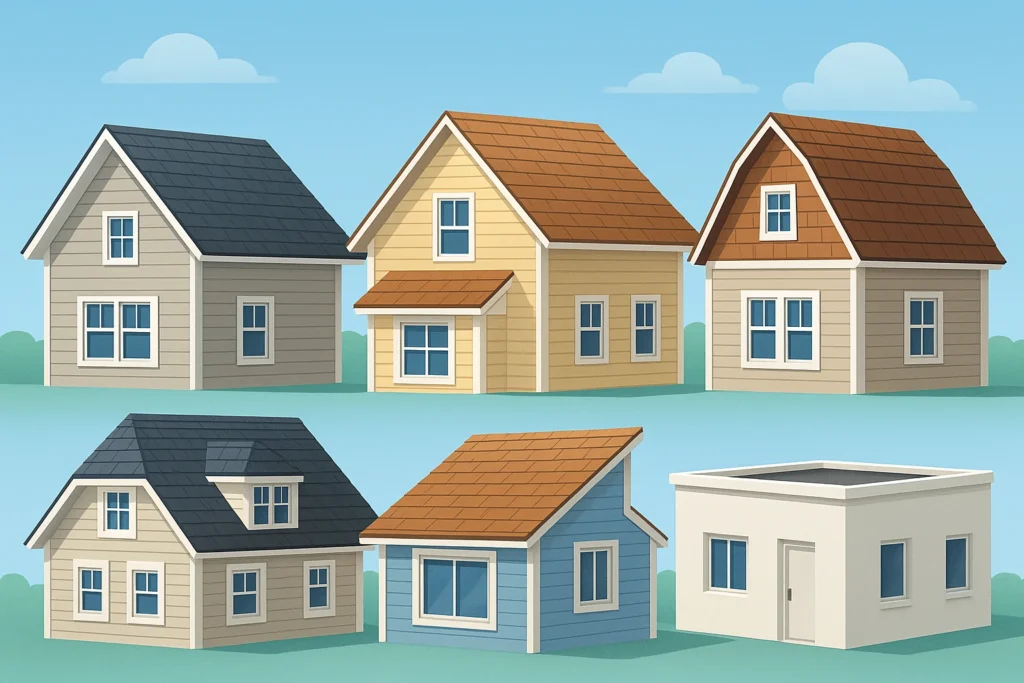
The gable roof is one of the easiest to identify. It has two sloping sides that meet at a ridge, forming a triangle when viewed from the front.
- Why it’s common: Simple design, cost-effective construction.
- Best for: Rainy or snowy climates since water runs off easily.
- Consideration: Vulnerable to wind uplift in storm-prone regions.
2. 🏡 Hip Roof: Balanced on All Sides
A hip roof slopes on all four sides and meets at a ridge. Its even shape provides better stability than a gable roof.
- Strengths: Excellent wind resistance and strong drainage.
- Best for: Areas with hurricanes or frequent storms.
- Note: More complex structure means higher construction costs.
3. 🏚️ Gambrel Roof: The Barn-Style Look
A gambrel roof is easy to spot with its two slopes on each side—the lower slope is steep, and the upper slope is gentle.
- Benefits: Maximizes attic or loft space.
- Where you see it: Barns, colonial-style homes, and some farmhouses.
- Consideration: Less stable in high-wind regions without reinforcements.
4. 🏛️ Mansard Roof: French Elegance
Similar to the gambrel, a mansard has four sides with two slopes each. The lower slope is steep, often with dormer windows.
- Benefits: Expands living space without adding another story.
- Famous for: French-inspired architecture and historic townhouses.
- Note: Requires regular maintenance to prevent water pooling.
5. 🏗️ Shed Roof: Modern and Minimalist
A shed roof has a single sloping surface—like half a gable. It’s often used in modern home designs.
- Strengths: Allows large windows for natural light, simple structure.
- Best for: Home extensions, studios, or contemporary designs.
- Drawback: Works better in mild climates since one slope bears all the weather.
6. 🏢 Flat Roof: Functional and Versatile
Flat roofs look level but usually have a slight slope for drainage. They’re popular in commercial buildings and modern homes.
- Advantages: Space for solar panels, rooftop decks, or HVAC units.
- Best for: Urban areas where outdoor space is limited.
- Fact: Flat roofs require proper drainage systems to prevent pooling and leaks.
📑Roof Styles at a Glance
| Roof Style | Shape | Best Feature | Common Use |
|---|---|---|---|
| Gable Roof | Two sloping sides, triangular peak | Simple, affordable | Suburban homes |
| Hip Roof | Four sloping sides | Wind-resistant | Coastal, storm-prone areas |
| Gambrel Roof | Two slopes per side | Extra attic space | Barns, colonial homes |
| Mansard Roof | Four sides, double slope | Expands living area | French-inspired homes |
| Shed Roof | Single slope | Modern design, natural light | Extensions, modern homes |
| Flat Roof | Nearly level | Usable rooftop space | Commercial buildings, modern homes |
🔨 Common Roofing Materials and How to Recognize Them
🧱 Asphalt Shingles
- Most common in the U.S.
- Lifespan: 20–25 years (NAHB).
- Easy to spot: layered, rectangular shingles.
🌲 Wood Shingles and Shakes
- Natural, rustic look.
- Shingles are smooth-cut, shakes are hand-split.
- Require regular maintenance to resist rot.
Slate Roofing
- Durable, elegant, and heavy.
- Can last 100+ years with proper care.
- Expensive but adds high resale value.
🔩 Metal Roofing
- Lightweight and reflective.
- Cuts cooling costs by up to 15% (U.S. Department of Energy).
- Strong against wind, fire, and snow.
🧪 Flat Roof Materials (EPDM, TPO, Bitumen)
- Often used in commercial buildings.
- Flexible, durable, and cost-effective.
- Designed for easy installation and leak resistance.

📌 Roof Lifespans by Material
| Material | Average Lifespan |
|---|---|
| Asphalt Shingles | 20–25 years |
| Wood Shingles/Shakes | 25–30 years |
| Metal Roofing | 40–50 years |
| Slate Roofing | 100+ years |
| Flat Roof Membranes | 20–30 years |
👷 Why Professional Identification Helps
While homeowners can identify roof styles by shape, confirming materials and condition often requires professional inspection. Roofers check ventilation, flashing, underlayment, and drainage. The NRCA recommends at least two inspections a year to extend roof life and prevent hidden damage.
👉 For accurate identification and expert help, visit Akron Roofing Experts.
🏠 Choosing the Best Roof for Your Home
Selecting the right roof depends on:
- Climate: Hip or metal roofs suit windy areas; steep-slope roofs handle heavy snow.
- Budget: Asphalt shingles are affordable; slate and metal cost more but last longer.
- Style: Mansard or slate for elegance, shed for modern looks.
- Energy needs: Metal and cool-roof shingles improve efficiency.
❓ Frequently Asked Questions
⭐ Final Thoughts
Knowing what type of roof you have helps you make smart decisions about maintenance, repairs, and upgrades. Each style—from gable to flat—has unique strengths, lifespans, and care requirements. Understanding your roof type also prepares you for insurance claims, resale value discussions, and long-term planning.
If you’re unsure, don’t guess—schedule a professional inspection for peace of mind. For expert guidance, contact Akron Roofing Experts.