- Introduction
- What Is Roof Pitch and Why It Matters
- How Roof Pitch Is Expressed
- Quick Math — Convert Pitch, Percent, and Degrees (Step-by-step)
- Roof Pitch Chart (Rise/12 → Decimal → Percent → Degrees → Typical Uses)
- Common Roof Types and Typical Pitch Ranges
- Choosing Roofing Materials by Pitch (Facts, not opinions)
- How to Measure Roof Pitch — Safe, Accurate Methods
- Calculating Rafter Length and Roof Area (Basic formulas and example)
- Snow, Wind, and Climate — How Pitch Affects Performance
- Installation and Safety Notes (Facts and best practices)
- Example Projects — Real-Life Numbers
- Maintenance Differences by Pitch
- Common Mistakes and How to Avoid Them
- Tools and Resources You Need
- Quick Conversion Reference
- FAQs
Introduction
Have you ever stood under a leaking ceiling and wondered, “How steep is my roof and will the repair hold up?” I’ve been there—confused by contractor talk about “six in twelve” and unsure how slope affects materials or cost. This guide explains roof pitch clearly, shows a full roof pitch chart, and gives step-by-step measurement and conversion methods. It helps homeowners and professionals make data-driven decisions.
What Is Roof Pitch and Why It Matters
Roof pitch (also called roof slope) describes how steep a roof is. It matters because pitch affects water run-off, snow shedding, material choices, structural load, and code requirements. Pitch helps determine:
- Which roofing materials will perform well.
- How much underlayment or flashing is needed.
- The length of rafters and amount of roofing material.
- Maintenance needs and safety risks during repair.
A clear chart and simple math make these decisions reliable, not guesswork.
How Roof Pitch Is Expressed
Roof pitch uses three common formats:
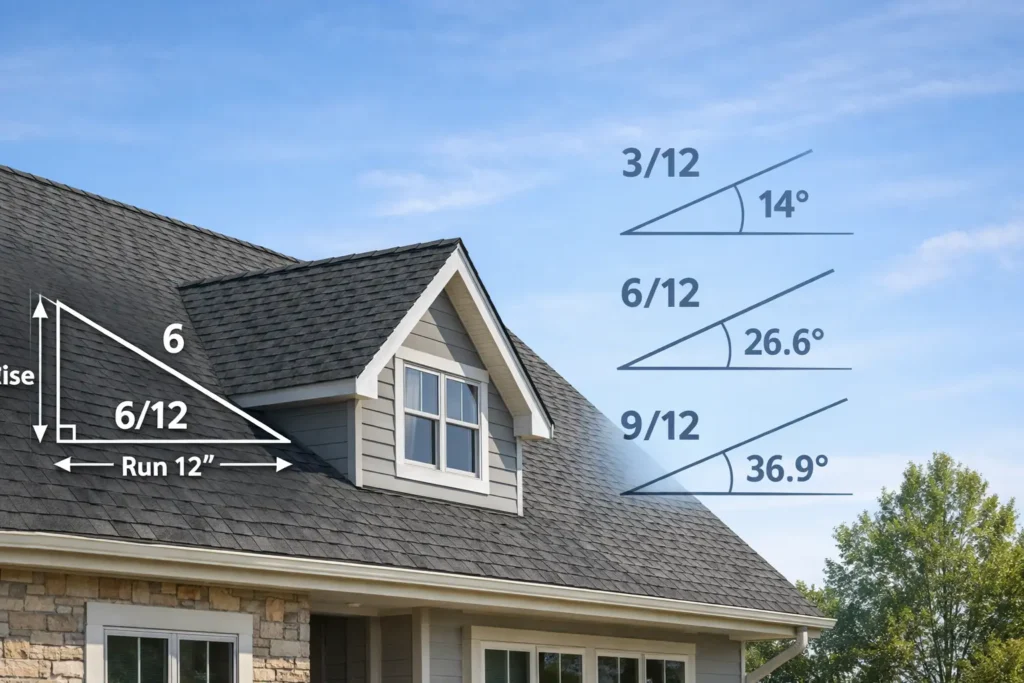
- Rise over run (X/12) — This is the standard in the U.S. It shows how many inches the roof rises vertically for every 12 inches horizontal. Example: 6/12 means 6 inches up for 12 inches across.
- Percent slope — Rise divided by run, then multiplied by 100. Example: 6/12 → 6 ÷ 12 = 0.5 → 0.5 × 100 = 50%.
- Angle in degrees — Use trigonometry: degrees = arctan(rise ÷ run). Example: 6/12 → arctan(0.5) ≈ 26.565°.
All three tell the same story in different forms. Professional plans may use any of these; understanding conversions keeps everyone on the same page.
Quick Math — Convert Pitch, Percent, and Degrees (Step-by-step)
Use these steps to convert a pitch (rise/12) into percent and degrees.
Step 1 — Convert to slope decimal
- slope = rise ÷ 12
Example: For 6/12, slope = 6 ÷ 12 = 0.5.
Step 2 — Convert to percent
- percent = slope × 100
Example: 0.5 × 100 = 50%.
Step 3 — Convert to degrees
- degrees = arctan(slope)
Example: degrees = arctan(0.5) ≈ 26.565°. (This is a standard trig function; most calculators show it as arctan or tan⁻¹.)
These three numbers (0.5, 50%, 26.6°) describe the same steepness.
Roof Pitch Chart (Rise/12 → Decimal → Percent → Degrees → Typical Uses)
Below is a practical pitch chart commonly used by roofers and designers. Bold the main phrase Roof Pitch Chart in your notes if you need to find it fast.
| Pitch (X/12) | Slope (decimal) | Percent (%) | Angle (°) | Typical uses / material suitability |
|---|---|---|---|---|
| 0/12 | 0.000 | 0% | 0° | Flat roofs — require membrane systems (EPDM, TPO, PVC). |
| 1/12 | 0.083 | 8.33% | 4.76° | Very low slope — special waterproofing; not suitable for shingles. |
| 2/12 | 0.167 | 16.7% | 9.46° | Low slope — some shingles allowed with special underlayment; membranes preferred. |
| 3/12 | 0.250 | 25% | 14.04° | Low-moderate — many shingles can be used; good for gutters and water run-off. |
| 4/12 | 0.333 | 33.3% | 18.43° | Common for bungalows; asphalt shingles, metal, and tiles possible. |
| 5/12 | 0.417 | 41.7% | 22.62° | Good for many shingle types and tile with proper underlayment. |
| 6/12 | 0.500 | 50% | 26.57° | Very common residential pitch; shingles and tile perform well. |
| 7/12 | 0.583 | 58.3% | 30.26° | Steeper roofs shed snow and debris easily. |
| 8/12 | 0.667 | 66.7% | 33.69° | Typical for steep gables; allows decorative features. |
| 9/12 | 0.750 | 75% | 36.87° | Steep — tile and slate common; greater wind uplift concerns. |
| 10/12 | 0.833 | 83.3% | 39.81° | Very steep — special safety during installation, higher material cost. |
| 11/12 | 0.917 | 91.7% | 42.51° | Steep architectural roofs; often used for style and snow shedding. |
| 12/12 | 1.000 | 100% | 45° | 45-degree roof — visually dramatic and effective in snowy climates. |
This chart helps match roof type and material recommendations to pitch. Use it when planning replacement, inspection, or design.
Common Roof Types and Typical Pitch Ranges
Knowing pitch ranges helps select styles and materials.
- Gable roof: 4/12 to 9/12. Simple, economical, and common for many homes.
- Hip roof: 5/12 to 9/12. Strong against wind; all sides slope down to walls.
- Shed roof (single slope): 1/12 to 6/12. Used for additions and modern homes.
- Mansard roof: Varies widely; lower and upper slopes create extra attic space.
- Gambrel roof: Steeper lower slope and shallower upper slope; often 10/12 lower and 4/12 upper.
Choosing Roofing Materials by Pitch (Facts, not opinions)
Material performance depends on pitch. These are industry-backed guidelines commonly used by manufacturers and building codes:
- Membrane roofing (EPDM, TPO, PVC): Designed for low slopes and flat roofs (0–3/12). Reliable waterproofing where shingles would leak.
- Asphalt shingles: Common on residential homes. Many manufacturers allow use at pitches of 2/12 or greater, but most recommend 3/12 minimum for long-term performance. Always follow the shingle maker’s installation instructions.
- Metal roofing (standing seam): Works across a wide range; often used from 3/12 upwards. Special seam designs allow good performance on low slopes if specified by manufacturer.
- Tile and slate: Require steeper slopes—typically 4/12 or higher—and secure underlayment. Heavy; roof framing must support weight.
- Wood shakes: Commonly used on slopes 4/12 and up with careful flashing and underlayment.
These constraints come from product testing and manufacturer warranties. Using a material outside its recommended pitch can void warranties and increase leak risk.
How to Measure Roof Pitch — Safe, Accurate Methods
Measuring pitch is simple if you take safe steps.
From the attic (safest method)
- Locate a rafter with clear exposure.
- Place a level horizontally on the rafter so it spans 12 inches (use a 12-inch or longer level).
- Measure the vertical distance from the end of the level to the rafter top. That vertical rise in inches is the pitch rise per 12.
- Record as X/12.
Example: If the vertical distance = 6 inches, roof pitch = 6/12.
Outside, from the ground
- Use a long level or a contractor’s level and a tape measure.
- Hold the level level horizontally at a known length (e.g., 24 inches).
- Measure vertical rise at the end and convert to rise per 12.
This method is riskier; use binoculars or a ladder only if trained and safe.
Using a smartphone app or angle finder
Many apps use phone sensors to give degrees. Convert degrees to pitch by using tangent:
- slope = tan(degrees)
- rise per 12 = slope × 12
Smartphone readings may vary; verify with attic or level method when possible.
Calculating Rafter Length and Roof Area (Basic formulas and example)
Roof framing math uses the Pythagorean theorem for rafters and simple multiplication for area.
Rafter length (per foot of run)
- Run (half the building width) and rise (pitch × run) form a right triangle.
- Rafter length = √(run² + rise²).
Example — Simple, step-by-step:
- Building width = 24 ft. Half width (run) = 12 ft.
- Pitch = 6/12, so for each foot of run rise = 6/12 ft = 0.5 ft.
- Total rise over 12 ft = 0.5 × 12 = 6 ft.
- Rafter length = √(run² + rise²) = √(12² + 6²) = √(144 + 36) = √180 ≈ 13.416 ft.
So each rafter (straight length from plate to ridge) is about 13.42 ft before adding birdsmouth cuts or overhang.
Roof area calculation
- Multiply plan area by roof factor (accounts for slope)
- Roof factor = √(1 + slope²) where slope = rise ÷ run (in feet per foot).
Example continuing above:
- slope = 6 ÷ 12 = 0.5
- roof factor = √(1 + 0.5²) = √(1 + 0.25) = √1.25 ≈ 1.118
- If plan area (flat footprint) = 24 ft × 30 ft = 720 ft² per side? For a simple gable, total roof area ≈ plan area × roof factor = 720 × 1.118 ≈ 805 ft² per side; multiply by number of sides as appropriate.
These calculations influence material purchase and cost.
Snow, Wind, and Climate — How Pitch Affects Performance
Pitch directly influences how a roof handles weather:
- Snow: Steeper roofs shed snow faster. In heavy-snow zones, designers increase pitch to lower snow load or install snow guards and stronger framing. Building codes in cold climates often specify design snow loads; consult local code.
- Wind: Steep roofs can increase wind uplift forces on shingles and tiles. Proper fastening, high-quality underlayment, and code-compliant nailing patterns reduce uplift risk.
- Rain: Low slopes must use watertight membranes and precise flashing because water moves slowly and can pond.
- Sun and HVAC: Steep roofs create more attic volume and ventilation needs. Proper venting keeps insulation dry and systems efficient.
These are engineering realities used by roofers and code officials to design durable roofs.
Installation and Safety Notes (Facts and best practices)
- Follow manufacturer instructions for slope minimums — using materials outside allowed pitches risks failure.
- Use certified installers for specialized systems (metal standing seam, tile, membrane).
- Clamp-on roof anchors, fall protection, and harnesses are standard for steep roofs. OSHA sets worker-protection rules for residential contractors.
- Inspect flashing at valleys, chimneys, skylights, and penetrations carefully — these are common leak points regardless of pitch.
Example Projects — Real-Life Numbers
Project A — Small bungalow
- Footprint: 28 ft × 36 ft = 1008 ft².
- Pitch: 5/12 → slope = 0.417 → roof factor ≈ √(1 + 0.417²) = √(1 + 0.1739) = √1.1739 ≈ 1.0835.
- Estimated roof area = 1008 × 1.0835 ≈ 1,092 ft² per side; double-check for both slopes and overhangs.
- Material: architectural asphalt shingles (common for 5/12).
Project B — Modern shed addition
- Footprint: 12 ft × 20 ft = 240 ft².
- Pitch: 2/12 (low slope) → slope = 0.167 → membrane roofing recommended.
- Roof area = 240 × √(1 + 0.167²) ≈ 240 × 1.0139 ≈ 243 ft².
These examples show how pitch changes material choice and area.
Maintenance Differences by Pitch
- Low slope (<3/12): Inspect membranes regularly for ponding and seam failure. Remove debris to avoid ponding.
- Moderate pitch (3/12–7/12): Routine shingle checks, flashing inspections, and gutter cleaning.
- Steep slope (>7/12): Safety-first maintenance; more frequent inspections after storms; tiles and slates need periodic fastener checks.
Common Mistakes and How to Avoid Them
- Guessing pitch from the ground — verify with a level or attic method.
- Ignoring manufacturer slope limits — warranty voids and leaks result.
- Underestimating rafter length and waste — order extra material for cuts and overlaps.
- Overlooking flashing details — valleys and penetrations cause most leaks.
Tools and Resources You Need
Practical tools for pitch measurement and planning:
- 12-inch carpenter’s level and tape measure.
- Long contractor’s level (24–48 inches) for outside reads.
- Angle finder or digital inclinometer for degree readings.
- Calculator for conversions, or an online roof pitch calculator.
- Safety gear: ladder, harness, roof anchor, non-slip shoes.
Quick Conversion Reference
| Pitch | Decimal | Percent | Degrees |
|---|---|---|---|
| 2/12 | 0.167 | 16.7% | 9.46° |
| 3/12 | 0.250 | 25.0% | 14.04° |
| 4/12 | 0.333 | 33.3% | 18.43° |
| 5/12 | 0.417 | 41.7% | 22.62° |
| 6/12 | 0.500 | 50.0% | 26.57° |
| 7/12 | 0.583 | 58.3% | 30.26° |
| 8/12 | 0.667 | 66.7% | 33.69° |
| 9/12 | 0.750 | 75.0% | 36.87° |
| 12/12 | 1.000 | 100.0% | 45.00° |
Conclusion — Make Smart Roofing Decisions
A reliable Roof Pitch Chart and the ability to measure, convert, and apply pitch data reduce surprises. Pitch determines material performance, safety needs, and long-term costs. Use the attic method for safe measurement, follow manufacturer pitch recommendations, and calculate rafter length and roof area before ordering materials.
For professional inspection, precise calculation, or to schedule a pitch confirmation and quote, visit akronroofingexperts.com for detailed services and certified installers.
FAQs
Final call to action
If you want a professional roof pitch check, precise material recommendations, or a full roof estimate from certified pros, visit akronroofingexperts.com and request a site visit. Getting the pitch right now avoids costly repairs later.