
- 🌟 Introduction: Are Old Blueprints Holding Back Your Projects?
- 📄 From Pencils to Pixels: The Evolution of Drawings
- 👷 Why CAD Drawings Are Transforming Construction and Roofing
- 📊 Comparing Traditional Blueprints vs. CAD Drawings
- 🏠 CAD in Roofing: More Than Just Design
- 📚 Real-World Applications of CAD in Construction
- 📑 CAD Applications Across Project Types
- 🧠 CAD and Safety Standards
- 📈 Economic Impact of CAD in Construction
- 💡 Future of CAD in Roofing and Construction
- 📖 FAQs About CAD in Roofing and Construction
- ⭐ Conclusion: Building Smarter with CAD
🌟 Introduction: Are Old Blueprints Holding Back Your Projects?
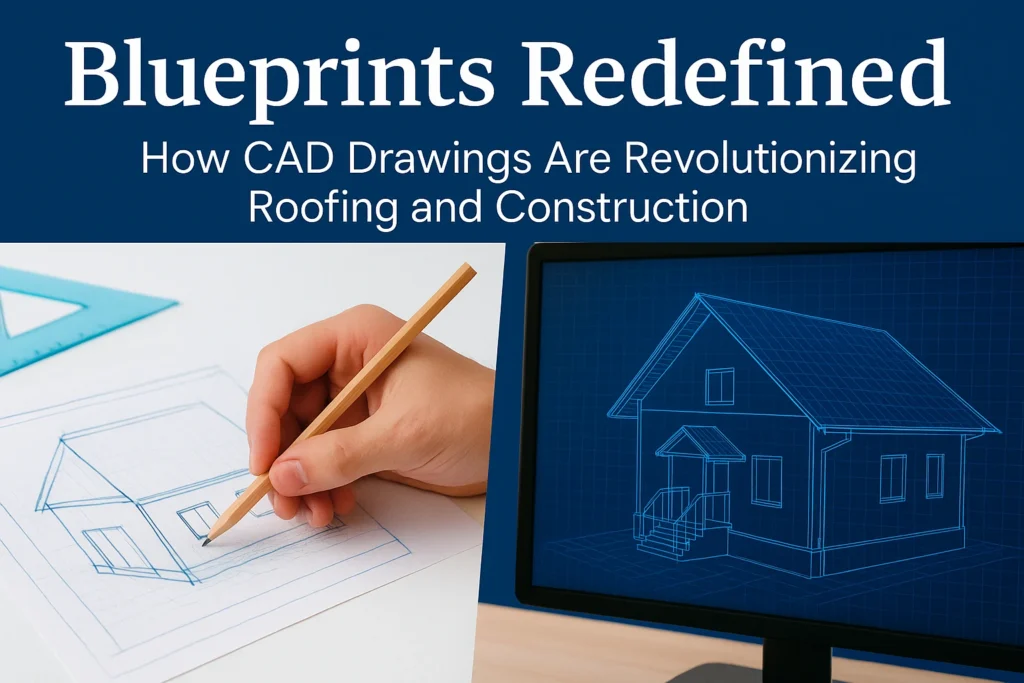
Have you ever wondered if hand-drawn blueprints are limiting the speed, accuracy, and cost-effectiveness of your construction or roofing projects? I’ve asked myself the same question while looking at projects delayed because of errors or last-minute changes. In today’s fast-moving world, small mistakes can lead to huge costs. That’s where Computer-Aided Design (CAD) drawings come in—redefining how professionals approach roofing and construction.
📄 From Pencils to Pixels: The Evolution of Drawings
For centuries, construction relied on hand-drawn blueprints. These drawings required skill but carried several problems:
- 🕒 Time-consuming to create and revise
- 📝 Prone to human error
- 🔄 Difficult to update after completion
The shift to CAD was a breakthrough. Introduced in the 1960s, CAD technology started with big corporations but gradually became mainstream. Today, even small contractors can access 2D and 3D CAD tools. This evolution replaced guesswork with precision, allowing designers, engineers, and roofers to visualize projects before building begins.
👷 Why CAD Drawings Are Transforming Construction and Roofing
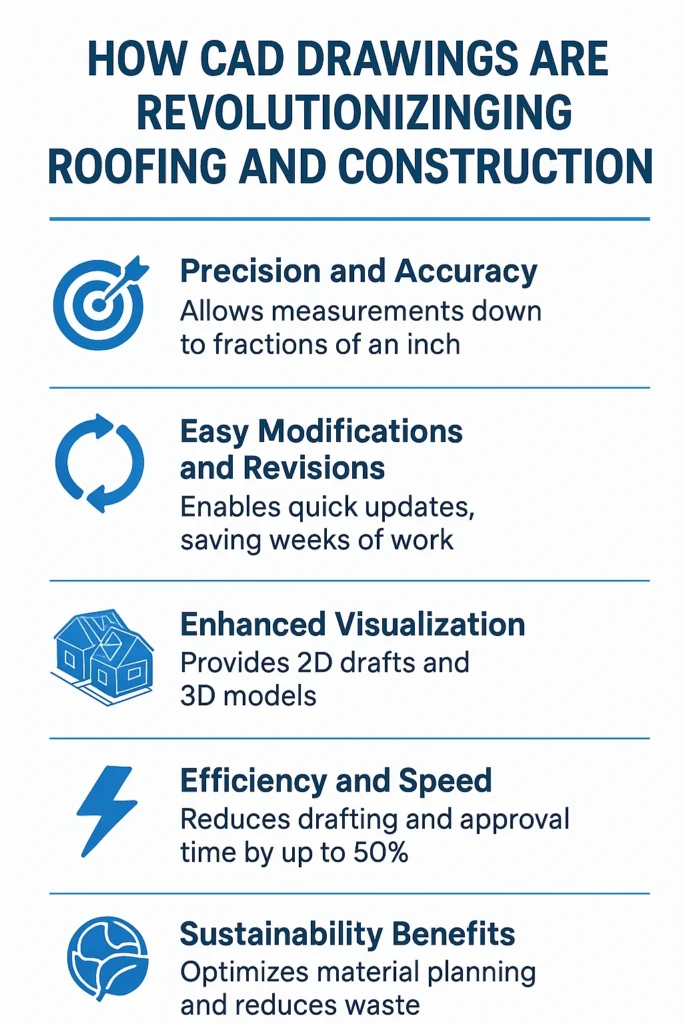
1. 🎯 Precision and Accuracy
- CAD allows measurements down to fractions of an inch.
- Mistakes in construction can cost 10–15% of project budgets, according to the Construction Industry Institute.
- Accurate CAD designs minimize material waste and prevent costly rework.
2. 🔄 Easy Modifications and Revisions
- Traditional blueprints made changes slow and difficult.
- CAD enables quick updates, saving weeks of work.
- Contractors can adapt to last-minute client requests without delaying the project.
3. 🖼️ Enhanced Visualization
- CAD provides 2D drafts and 3D models.
- Clients can see a realistic view of their roof or building before construction begins.
- Visualization reduces misunderstandings and improves decision-making.
4. ⚡ Efficiency and Speed
- CAD reduces drafting and approval time by up to 50%.
- Contractors complete projects faster and take on more clients.
- Automated features like templates and libraries save additional time.
5. 🌍 Sustainability Benefits
- Optimized material planning reduces waste.
- Digital models allow better planning for energy efficiency.
- Green construction practices become easier to implement.
For professional support in roofing projects, visit Akron Roofing Experts.
📊 Comparing Traditional Blueprints vs. CAD Drawings
| Feature | Traditional Blueprints | CAD Drawings |
|---|---|---|
| Accuracy | Prone to human error | Highly precise |
| Revisions | Time-consuming | Quick and flexible |
| Visualization | Flat, 2D only | 2D + 3D realistic models |
| Efficiency | Slower drafting | Faster completion |
| Waste Reduction | Limited control | Optimized material use |
🏠 CAD in Roofing: More Than Just Design
CAD isn’t just for architects—it’s transforming roofing. Roofers use CAD to:
- 📐 Plan exact roof slopes and drainage
- 🧱 Visualize shingle layouts and material placement
- 💨 Account for wind and snow loads
- 🛠️ Reduce installation errors
According to the National Roofing Contractors Association (NRCA), CAD-based roofing plans improve installation accuracy by 30–40% compared to traditional methods.
📚 Real-World Applications of CAD in Construction
🏗️ Residential Homes
- Homeowners see 3D previews before work begins.
- CAD ensures precise fitting for materials like shingles, tiles, or metal roofing.
🏢 Commercial Projects
- Complex commercial buildings require detailed designs.
- CAD manages large-scale coordination among multiple teams.
🛠️ Remodeling and Renovations
- Contractors can overlay new CAD drawings on old structures.
- Reduces risks when blending modern designs with existing buildings.
🏭 Industrial Sites
- CAD helps plan large warehouses, factories, and roof support systems.
- Accounts for heavy equipment, ventilation, and energy efficiency.
📑 CAD Applications Across Project Types
| Project Type | CAD Advantage | Result |
|---|---|---|
| Residential | 3D previews for clients | Better decision-making |
| Commercial | Complex coordination | Fewer conflicts |
| Remodeling | Overlay with old plans | Safer renovations |
| Industrial | Load calculations | Stronger structures |
🧠 CAD and Safety Standards
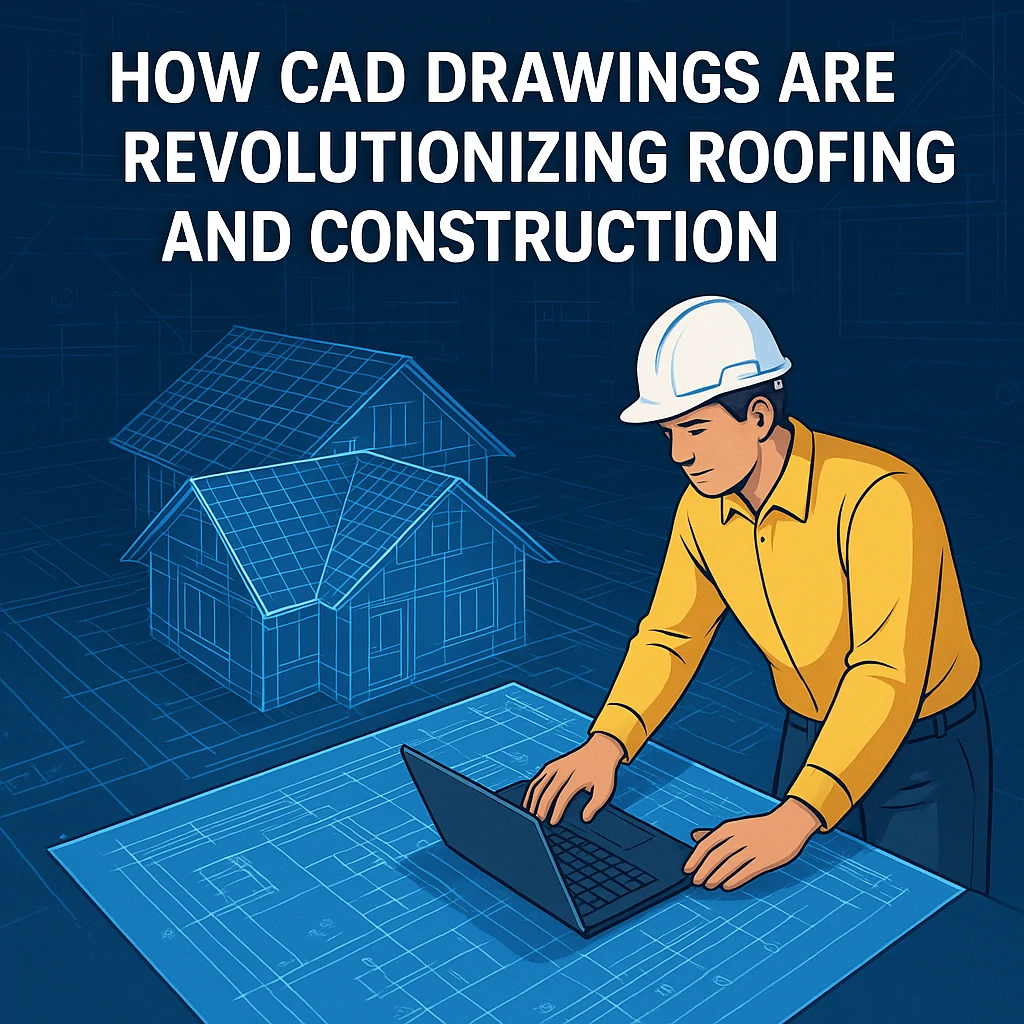
Construction safety is not optional. CAD plays a big role in meeting building codes and OSHA guidelines.
- CAD checks stress points and structural integrity.
- Safety hazards are identified before construction begins.
- Compliance with International Building Code (IBC) becomes easier.
📈 Economic Impact of CAD in Construction
- According to McKinsey, CAD and related technologies reduce project costs by up to 20%.
- Projects finish faster, improving contractor profitability.
- Material waste drops significantly, saving both money and resources.
💡 Future of CAD in Roofing and Construction
CAD is not stopping here. Emerging trends include:
- 🤖 AI-powered CAD for predictive design improvements
- 🥽 Augmented Reality (AR) to overlay CAD models on real sites
- ☁️ Cloud-based CAD platforms for global team collaboration
- 🌱 Green building simulations for sustainable roofing and construction
These innovations will continue to redefine how contractors and homeowners plan, design, and build.
📖 FAQs About CAD in Roofing and Construction
⭐ Conclusion: Building Smarter with CAD
The construction and roofing industry has moved far beyond paper blueprints. With CAD, contractors achieve accuracy, speed, safety, and sustainability. Homeowners benefit from realistic previews, fewer delays, and cost savings. As technology advances, CAD will only become more powerful, changing how we design and build for decades to come.
For reliable roofing services powered by modern planning, visit Akron Roofing Experts.