- 📘 What are UPVC Roofing Sheets?
- 🛠️ How manufacturers make UPVC roofing sheets
- 📊 Key technical specifications (what to check when choosing a manufacturer)
- ⭐ Why builders and owners choose UPVC Roofing Sheets
- 🧩 UPVC vs other roofing options
- 📐 Typical product profiles and what they mean for your roof
- 🛠️ Installation best practices (to protect product warranty and performance)
- 🔍 Quality checks when selecting a UPVC Roofing Sheets Manufacturer
- 🔩 Common specifications manufacturers publish
- 🧰 Maintenance: keep your UPVC roof performing well
- 🌍 Environmental and safety considerations
- 💰 Cost and lifecycle economics
- 🏭 Choosing the right UPVC Roofing Sheets Manufacturer — checklist
- 📚 Two tables to help you decide (spec sheet + selection guide)
- ❓ Frequently Asked Questions
- Choosing an installer and warranty tips
- 🧾 Case example (how UPVC solved a specific problem)
- 🔚 Conclusion
- 📝 Final checklist before you sign a purchase order
Are you tired of roofs that leak, heat your rooms, and demand constant repairs? I’ve seen too many homeowners and builders stuck with heavy metal roofs that rust, or tiles that crack under sun and rain. That’s why I want to show you a smarter roofing option: UPVC roofing sheets built by reliable manufacturers for long life, low maintenance, and better thermal comfort.
📘 What are UPVC Roofing Sheets?
UPVC stands for unplasticized polyvinyl chloride. Unlike flexible PVC, UPVC is rigid and engineered for building uses. Manufacturers produce UPVC roofing sheets by compounding UPVC with UV-stable surface resins (often ASA or similar), reinforcing mesh (sometimes fiberglass), and additives that improve color stability and fire resistance. The result is a lightweight, corrosion-resistant roof panel that works for homes, warehouses, greenhouses, and industrial sheds.
🛠️ How manufacturers make UPVC roofing sheets
Manufacturing steps typically include raw-material blending, extrusion or co-extrusion (to create multi-layer panels), pressing/embossing for profile, cooling, cutting to length, and quality testing. Many producers apply a weather-resistant surface layer to reduce fading and a reinforcing layer for extra strength. These manufacturing choices determine thermal performance, sound insulation, and fire behavior.
📊 Key technical specifications (what to check when choosing a manufacturer)
| Property | Typical range / value | Why it matters |
|---|---|---|
| Thickness | 2.0 mm – 4.0 mm | Thicker panels resist impact and load better. |
| Total Width (standard) | ~940–1050 mm | Determines coverage per sheet and seam count. |
| Thermal conductivity | ≈ 0.07–0.325 W/m·K (product-dependent) | Lower = better insulation; improves indoor comfort and cooling costs. |
| Sound insulation | 12–30 dB (depending on structure) | Reduces rain and industrial noise. |
| Weight | ~4–6 kg/m² (much lighter than metal sheets) | Easier handling, cheaper supporting structure. |
| Temperature range | -40°C to +80°C (varies by product) | Handles extreme climates without cracking. |
| Fire rating | Many products test to B1 / B-grade (GB8624-2006 standard or equivalent) | Fire performance varies by formulation—check lab test reports. |
| Chemical resistance | Resistant to acids, alkalis, salt spray | Good for coastal, industrial environments. |
⭐ Why builders and owners choose UPVC Roofing Sheets
- 🔸 Thermal comfort and energy savings. UPVC sheets transfer less heat into the building than many thin metal roofs. Depending on the product, low thermal conductivity helps cut cooling loads and reduces HVAC runtime.
- 🔸 Corrosion and chemical resistance. UPVC resists rust, salt spray, and many industrial chemicals—important for coastal zones and factories.
- 🔸 Lightweight and safer to install. Being significantly lighter than metal sheets reduces dead load on structures and speeds up installation.
- 🔸 Low maintenance and long life. Well-made UPVC roofs commonly last multiple decades with routine cleaning and inspection. Field reports and manufacturer claims put typical life spans in a 25–50 year window depending on product and climate.
- 🔸 Better sound insulation vs thin metal. Multi-layer UPVC or fiber-reinforced variants deliver notable dampening of rain and impact noise.
🧩 UPVC vs other roofing options
| Feature | UPVC | Metal (galvanized/colour steel) | Clay / Concrete Tiles |
|---|---|---|---|
| Thermal insulation | Good (low k) | Poor (thin metal conducts heat) | Moderate (tiles store heat) |
| Weight | Light | Light–moderate | Heavy |
| Corrosion resistance | High | Low without coating | High (but brittle) |
| Maintenance | Low | Medium (repainting, rust control) | Medium (broken tiles) |
| Lifespan | 25–50 years (product-specific) | 20–40 years (coating-dependent) | 30–100 years |
| Cost (installed) | Competitive | Variable | Often higher structural cost |
📐 Typical product profiles and what they mean for your roof
Manufacturers often offer different profile types: corrugated, multi-rib, tile-shaped, and insulated composite panels. Choose based on these priorities:
- Weather protection and runoff → steeper profiles and proper overlaps.
- Insulation and sound control → multi-layer or fiber-reinforced sheets.
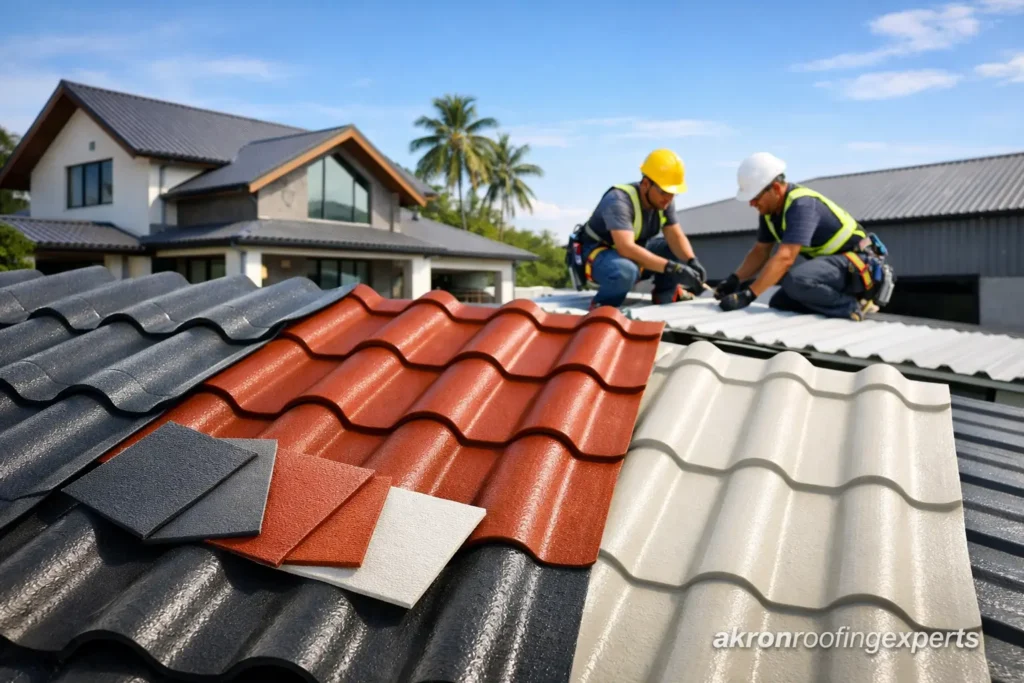
- Aesthetics → tile-shaped UPVC with ASA surface for color stability.
🛠️ Installation best practices (to protect product warranty and performance)
- 🔹 Correct slope: Most UPVC roofs need minimum slope recommendations (often ~8–10%). Low slope increases leak risk.
- 🔹 Seams & overlaps: Follow manufacturer overlap recommendations (transverse/longitudinal) and use proper sealing where needed.
- 🔹 Fastening: Use compatible fasteners with neoprene washers to prevent leaks and allow thermal movement.
- 🔹 Expansion gaps: Leave proper spacing to account for thermal expansion — UPVC expands more than metal.
- 🔹 Skilled installer: Use a team familiar with UPVC profiles and manufacturer instructions—good installation preserves life and performance.
🔍 Quality checks when selecting a UPVC Roofing Sheets Manufacturer
Make sure a manufacturer provides:
- Material data sheets (MDS) listing thermal conductivity, tensile strength, and fire test standards.
- Independent test reports for fire behavior (e.g., B1 or equivalent) and UV aging (QUV test hours).
- Warranty covering color fade, structural defects, and UV degradation.
- Clear installation instructions and technical support.
- Third-party references or documented projects in climates like yours (coastal, industrial, tropical).
🔩 Common specifications manufacturers publish
- Thickness — determines stiffness and load-bearing.
- Effective width — affects number of sheets and joints.
- Wave height / profile — affects water runoff and wind resistance.
- Thermal conductivity — helps predict heat transfer into buildings.
- Fire rating — required for certain industrial and commercial projects.
🧰 Maintenance: keep your UPVC roof performing well
- ✳️ Inspect twice a year and after storms.
- ✳️ Clean gutters and drains to prevent standing water.
- ✳️ Remove debris and organic growth (moss, leaves).
- ✳️ Check fasteners and flashings; replace worn washers.
- ✳️ Avoid harsh solvents—clean with mild detergent and water.
Following these steps extends life and keeps thermal and water performance optimal.
🌍 Environmental and safety considerations
- Recyclability: UPVC can be recycled where collection and recycling streams exist. Check local recycling options.
- Fire behavior: UPVC formulations used for building aim for limited combustibility; always check tested fire grade.
- Chemical resistance: UPVC tolerates many industrial environments and acid/salt exposure—useful in coastal or manufacturing settings.
💰 Cost and lifecycle economics
A direct price-per-square-meter comparison can favor thin metal sheets initially. However, when you factor in insulation savings, longer service life, and lower maintenance, certain UPVC products can be more economical over 10–25 years. Ask manufacturers for life-cycle cost examples and independent project case studies to confirm savings in your climate.
🏭 Choosing the right UPVC Roofing Sheets Manufacturer — checklist
- ✅ Product test data (thermal, UV, fire).
- ✅ Clear dimensional specs and cutting tolerance.
- ✅ Production capacity and lead times.
- ✅ Installation guides and technical support.
- ✅ Local installers trained on that product.
- ✅ Warranty terms and service network.
If the manufacturer can share completed project photos and contactable references, that is a strong plus.
📚 Two tables to help you decide (spec sheet + selection guide)
Technical example (sample product A)
| Spec | Value |
|---|---|
| Thickness | 2.5 mm |
| Effective width | 960 mm |
| Thermal conductivity | 0.07 W/m·K |
| Sound reduction | 25 dB |
| Fire grade | B1 (tested) |
| Temp range | -40°C to +80°C |
| Warranty | 10 years (color & structure) |
Selection guide for three common projects
| Project type | Recommended UPVC variant | Key focus |
|---|---|---|
| Warehouse / factory | Fiber-reinforced UPVC (3.0–4.0 mm) | Chemical & corrosion resistance, long spans |
| Residential home | ASA-surfaced UPVC tile profile (2.5–3.0 mm) | Aesthetics, thermal comfort |
| Greenhouse / farm | Translucent UPVC corrugated | Light transmission, weather resistance |
❓ Frequently Asked Questions
Choosing an installer and warranty tips
- Use an installer trained by the manufacturer.
- Keep purchase invoices, cut samples, and the product data sheet—these help claim warranty.
- Ask for a written installation checklist showing overlaps, fastener types, and expansion allowances.
🧾 Case example (how UPVC solved a specific problem)
A mid-size warehouse in a humid coastal area replaced corroded metal sheets with fiber-reinforced UPVC panels. After installation, the facility reported lower interior heat buildup and fewer routine repairs related to rust. The owner documented quieter interiors during heavy rain and lower HVAC runtime on hot afternoons—findings consistent with manufacturers’ thermal and sound data. (Example based on aggregated manufacturer case studies and field reports.)
🔚 Conclusion
If you want a roof that balances thermal comfort, low maintenance, and resistance to corrosion, consider UPVC roofing sheets from a manufacturer with independent test data and local installer support. Ask for material safety sheets, UV aging reports, fire test certificates, and warranty terms before you buy. For professional guidance, product comparison, or installation quotes, visit: akronroofingexperts.com
📝 Final checklist before you sign a purchase order
- ✔️ Confirm product thickness and profile suits your wind and snow load.
- ✔️ Review thermal conductivity and sound insulation figures.
- ✔️ Get fire-test documentation and UV ageing test reports.
- ✔️ Confirm overlap, fastener type, and installer competencies.
- ✔️ Retain warranty and maintenance instructions in writing.