- ❓ Have you ever paid too much for cooling or fixed the same roof leak again and again?
- 📄 What is a Puf Sandwich Roof Panel? 🧩
- 🔬 How the panel works 📐
- 🧱 Main components and materials📦
- 📊 Typical technical specifications 🧾
- ⚙️ Manufacturing process — how panels come to life 🏭
- 🔥 Thermal performance and energy impact 🌡️
- 🏗️ Structural strength and span capability 🏋️
- 🛠️ Installation — what installers do on site 🧰
- ✅ Advantages of Puf Sandwich Roof Panels 🌟
- ⚠️ Limitations and design cautions 🛑
- 🧾 Cost, lifecycle, and return on investment 💰
- 📂 Application examples and case uses
- 🧾 Standards, testing, and certifications
- 🔍 How to select the right Puf Sandwich Roof Panel
- 🔧 Maintenance and repair best practices 🛠️
- 📈 Performance case figures
- 🧾 Environmental and sustainability aspects🌿
- 🧑💼 Choosing a supplier and installer 🔎
- 🧾 Frequently Asked Questions ❓
- Puf Panels vs Common Alternatives 🧾
- Final checklist before you buy✔️
- 🔚 Conclusion
❓ Have you ever paid too much for cooling or fixed the same roof leak again and again?
I’ve helped owners and managers who felt stuck with old roofs that let heat, rain, and drafts into their buildings. A well-designed Puf Sandwich Roof Panel fixes those problems by combining strong outer skins with a thick, insulating core. It saves energy, speeds installation, and lasts for years. Read on to learn how these panels work, what real performance numbers mean, and how to choose the right panel for your building.
📄 What is a Puf Sandwich Roof Panel? 🧩
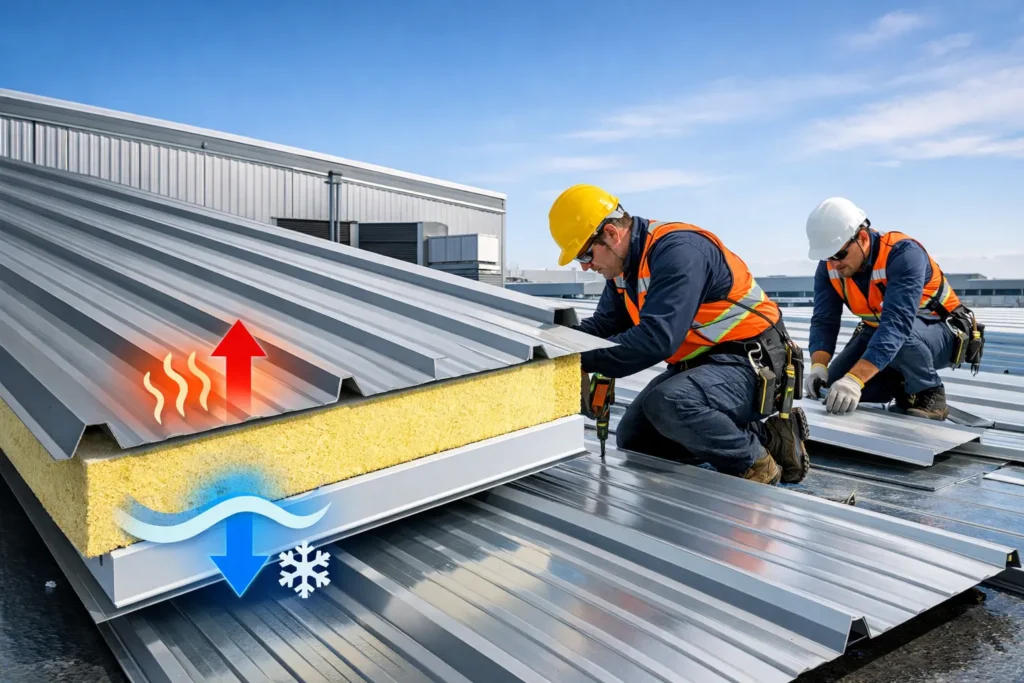
A Puf Sandwich Roof Panel is a factory-made roofing element with three main parts: two metal outer sheets and a core of rigid polyurethane foam (PUF). The foam bonds to the metal sheets, forming a single structural unit. That unit gives insulation, weather protection, and load-bearing capacity all at once. Buildings use these panels for warehouses, cold-storage, schools, factories, and commercial roofing that needs fast installation and steady thermal performance.
🔬 How the panel works 📐
Heat moves through roofs by conduction, convection, and radiation. The closed-cell foam core inside a Puf Sandwich Roof Panel traps air and lowers thermal conductivity, so the roof transfers much less heat than plain metal or concrete. The bonded outer skins carry mechanical loads while the foam keeps the structure rigid and stable. Together they cut HVAC runtime and reduce condensation risk inside the building.
🧱 Main components and materials📦
🔩 Outer skins (metal layers)
- Galvanized steel, galvalume, or aluminum usually form the top and bottom faces.
- Factories apply durable paint coatings such as SMP, PVDF, or similar finishes to resist UV and corrosion.
🧪 Foam core (PUF)
- Rigid polyurethane foam with closed cells gives low thermal conductivity and high insulation value.
- Typical foam density for roofing cores sits around 40 kg/m³ ±2 kg/m³ in many manufacturing standards.
🧰 Seals and fasteners
- Panels use factory-formed joints and mechanical fasteners during installation.
- Silicone or polymer seals ensure weather-tight laps at joints and penetrations.
📊 Typical technical specifications 🧾
| Property | Typical Value / Range | Why it matters |
|---|---|---|
| Thickness | 30 mm – 120 mm | Thicker core → higher insulation (lower heat transfer) |
| Effective width | ≈ 1000 mm | Affects how many panels cover a roof and overlap design |
| Thermal conductivity (λ) | 0.024 – 0.030 W/m·K | Lower number = better insulation |
| Core density | ~40 ±2 kg/m³ | Affects strength and thermal stability |
| Service temperature | −40 °C to +80 °C | Ensures performance in most climates |
| Wind resistance | Up to ~120 km/h (depending on fixing) | Important for areas with high winds |
| Fire class | B1/B2/PIR options (varies) | Fire rating affects building code compliance |
| Coating systems | SMP, PVDF, Polyester | Coating determines corrosion and color longevity |
Note: Values vary by manufacturer and local standards. Use manufacturer data for final design.
⚙️ Manufacturing process — how panels come to life 🏭
Factories produce Puf Sandwich Roof Panels using either continuous or batch processes that ensure strong bonding between skins and foam:
- Pre-treatment and roll-forming: Metal sheets receive a pre-treatment and roll-form to the desired profile.
- Panel assembly: The two metal skins line up in a forming machine with the core cavity between them.
- Foam injection: Polyol and isocyanate components mix and inject into the cavity. The foam expands and bonds to the metal faces.
- Curing and cutting: Panels cure to full strength, then machines cut them to specified lengths and trim edges.
- Quality control: Panels undergo checks for dimensional accuracy, bond strength, and surface finish.
- Packing and shipping: Factories pack panels with protective cover and label them for installation.
This controlled production yields consistent thermal and mechanical properties and shortens on-site work.
🔥 Thermal performance and energy impact 🌡️
A well-sized Puf Sandwich Roof Panel reduces heat flow into a building. Practical results:
- Lower U-value: Panels with thicker cores reach U-values better than many conventional roofs. (U-value depends on thickness and face materials.)
- HVAC savings: Buildings with properly insulated sandwich roofs can reduce cooling and heating energy use by 25–40% compared to uninsulated metal roofing systems in many climates. (Energy savings depend on climate, building use, and insulation thickness.)
- Condensation control: Closed-cell foam resists water absorption, reducing condensation risk under warm–cold cycles.
Designers use these performance traits to lower peak load on HVAC systems and improve indoor comfort stability.
🏗️ Structural strength and span capability 🏋️
A Puf Sandwich Roof Panel acts like a composite beam: the skins resist bending while the foam keeps them apart and transfers shear. This structure allows:
- Longer spans with thinner panels compared to single metal sheets.
- Uniform load distribution across the panel surface for live and wind loads.
- Lightweight construction: Panels reduce roof dead load and simplify support framing.
Engineers rely on manufacturer data for allowable spans, wind uplift resistance, and screw spacing. Always follow local building codes and structural calculations for safety.
🛠️ Installation — what installers do on site 🧰
Installers follow these steps to ensure a durable roof:
- Prepare purlins or roof structure to exact tolerances.
- Lay panels from eave to ridge, aligning male/female joints.
- Fasten panels at prescribed points with approved screws and washers.
- Seal overlaps and end laps using factory-recommended sealants or gaskets.
- Trim and flash around penetrations, ridges, and roof edges.
- Inspect finish, tightness, and watertightness after installation.
Proper installation is critical; poor fixing or wrong sealants cause leaks and thermal bridges.
✅ Advantages of Puf Sandwich Roof Panels 🌟
- High thermal insulation helps cut energy bills and improves indoor temperature stability.
- Fast installation shortens project schedules and reduces labor costs.
- Lightweight panels lower structural requirements for support framing.
- Good weather resistance when paired with suitable coatings and proper installation.
- Long service life with low maintenance if coatings and flashings remain intact.
- Versatile uses: cold-storage, industrial, commercial, institutional, and agricultural roofs.
⚠️ Limitations and design cautions 🛑
- Fire classification varies; choose a core and certificate that meet local codes for fire safety.
- Edge and joint detailing demand care; poor detailing causes leaks and heat loss.
- Acoustic performance: metal skins transmit sound more than massy roofs — extra acoustic layering may be required for noise-sensitive spaces.
- Cost vs. alternatives: upfront cost can exceed bare metal sheets, but lifecycle cost often favors sandwich panels due to energy savings.
🧾 Cost, lifecycle, and return on investment 💰
Calculate ROI by comparing:
- Upfront cost of panels + installation vs. cheaper roofing options.
- Operating savings from reduced energy consumption (HVAC runtime).
- Maintenance costs over time for coatings, sealants, and fasteners.
- Expected lifespan: quality panels with good coatings often last 20+ years.
In many climates and building types, reduced energy and lower maintenance produce a positive payback within several years. Use manufacturer R-values and local energy costs to model savings precisely.
📂 Application examples and case uses
- Cold-storage and food facilities: Panels provide steady thermal performance and help meet sanitary design needs.
- Industrial warehouses: Faster installation reduces downtime for large roofs.
- Commercial buildings and schools: Better indoor comfort and lower heating costs.
- Exhibition halls and sports centers: Lightweight long spans and custom finishes allow flexible designs.
🧾 Standards, testing, and certifications
Look for panels tested to recognized standards for thermal performance, bond strength, and coatings. Common evaluations include:
- Thermal conductivity and R-value testing under standardized laboratory methods.
- Bond strength tests to ensure foam adheres to metal faces.
- Corrosion resistance and paint durability (salt spray and weathering tests).
- Fire performance classification to local code requirements.
Request factory test reports, certificates, and third-party test results before purchase.
🔍 How to select the right Puf Sandwich Roof Panel
- Check building code requirements for fire, wind, and insulation.
- Match thickness and U-value to energy and comfort targets.
- Specify coating type (PVDF for long color life, SMP for general-purpose).
- Confirm core chemistry and density for required structural properties.
- Request wind uplift and span charts from the manufacturer.
- Verify installation instructions and warranty coverage.
🧾 Quick selection checklist
- 📄 Project code compliance confirmed.
- 👷 Manufacturer span and uplift charts reviewed.
- ✨ Coating warranty acceptable.
- 🔩 Approved fasteners and sealants specified.
- 🧪 Third-party test reports available.
🔧 Maintenance and repair best practices 🛠️
- Inspect roofs twice a year and after severe storms for loose fasteners, damaged coatings, and compromised seals.
- Replace damaged panels or patch minor damage with compatible materials.
- Clean surfaces periodically to remove debris that traps moisture and dirt.
- Recoat surfaces when paint warranties approach expiration to extend life and preserve thermal performance.
Routine maintenance keeps panels performing close to original specifications.
📈 Performance case figures
- A moderate warehouse using uninsulated metal roofing can see interior temperatures swing widely; upgrading to insulated sandwich panels can reduce peak heat gain by 20–40%, depending on climate and solar exposure.
- Energy modeling for similar building types commonly shows annual HVAC energy savings that justify thicker cores in hot or cold climates.
Use building-specific energy models to quantify savings before procurement.
🧾 Environmental and sustainability aspects🌿
- Polyurethane foam delivers efficient thermal performance, lowering energy use and carbon emissions over a building’s life.
- Many manufacturers offer foam formulations with low global-warming-potential blowing agents and reduced ozone-impact chemistry.
- End-of-life recycling options vary; check supplier programs for reclaiming metal skins and foam.
Selecting lower-impact materials and sound coatings helps meet sustainability targets.
🧑💼 Choosing a supplier and installer 🔎
- Confirm a supplier’s track record with references and completed projects.
- Ask for installation training, on-site supervision, and detailed technical data.
- Check warranty terms for both materials and workmanship.
- Prefer suppliers that provide engineering support and installation checklists.
If you need professional help, visit akronroofingexperts.com for expert guidance and project support.
🧾 Frequently Asked Questions ❓
Common installation mistakes to avoid⚠️
- Incorrect screw spacing or improper fastener type.
- Poor joint sealing and flashings at ridges, gutters, and penetrations.
- Mismatched panel profiles or insufficient support spacing.
- Using incompatible sealants or coatings for repairs.
Following manufacturer instructions and using trained crews avoids these failures.
Sample specification language for project documents 📄
Include in tender documents:
- Panel type: Puf Sandwich Roof Panel with rigid polyurethane core.
- Core density: ≥ 38–42 kg/m³ (or as required by structural design).
- Thermal conductivity: ≤ 0.030 W/m·K.
- Coating: PVDF or equivalent with specified warranty.
- Fire rating: Comply with local building code for roof assemblies.
Always adapt the specification to local standards and project needs.
Puf Panels vs Common Alternatives 🧾
| Feature | Puf Sandwich Panel | Single Metal Sheet | Built-up Roof |
|---|---|---|---|
| Insulation | High (integrated) | Low (needs added insulation) | Variable (layered) |
| Installation speed | Fast | Fast | Slower |
| Weight | Light | Very light | Heavy |
| Thermal performance | Excellent | Poor unless insulated | Good if designed |
| Lifespan | 20+ years (with maintenance) | 10–20 years | 15–30 years |
| Cost (initial) | Moderate–High | Low | Moderate–High |
| Maintenance | Low–moderate | Moderate | Moderate |
Final checklist before you buy✔️
- Confirm U-value and R-value for your climate and goals.
- Verify wind uplift and span tables for your roof.
- Ask for warranty documents for both coating and foam core.
- Request installation manual and site supervision if needed.
- Confirm fire rating and code compliance for the building type.
🔚 Conclusion
A properly specified and installed Puf Sandwich Roof Panel delivers insulation, structural performance, and long-term savings. It suits warehouses, cold-storage, commercial, and many industrial roofs. Use manufacturer test data, check local building codes, and hire experienced installers to secure the full benefit. For professional assessment, engineered selection, and installation help, visit akronroofingexperts.com.