- Intro
- Why this matters — quick facts you should know ⭐
- What makes a home truly eco-friendly? 👤
- At a glance — Table of the 13 homes (location + standout features) 📋
- Deep dive: the 13 homes — what they teach us
- 1. Swasya Living — managed farmland close to Bangalore 🌱
- 2. Hombelaku — earthen comfort in the city 🏡
- 3. Sanjay & Pratibha Singh House — passive first, tech second 🌿
- 4. N R House, Hyderabad — certified performance ✅
- 5. Farmer’s Home, Dakivali — rural, low-cost, high function 🚜
- 6. Hosamane — self-sufficient suburban model ☀️
- 7. Coconut Shells House, Mumbai — creative recycling 🥥
- 8. 100% Recyclable House, Haryana — full-cycle reuse 🔁
- 9. Kerala Eco-House — tradition plus modern systems 🌀
- 10. Laurie Baker Inspired House, Trivandrum — low cost, high value 🧱
- 11. Nature-Integrated Home, Guwahati — slope-sensitive design 🌄
- 12. Aangan, Ahmedabad — courtyard living for hot climates ☀️
- 13. Forest Retreat, Assam — bamboo and biodiversity 🌳
- Materials table — quick guide for builders (uses, benefits, cautions) 📋
- Energy, water, and money — real benefits with facts 🔎
- How to plan an eco home — a practical, step-by-step checklist ⭐
- Small retrofits that deliver big returns
- Policy & certification — where incentives exist 💡
- Quick comparison — payback & impact 📊
- Design rules that work in Indian climates
- How these homes affect health & resale value — evidence, not opinion
- Practical resources & next steps
- Final thoughts — short and practical 🎯
Intro
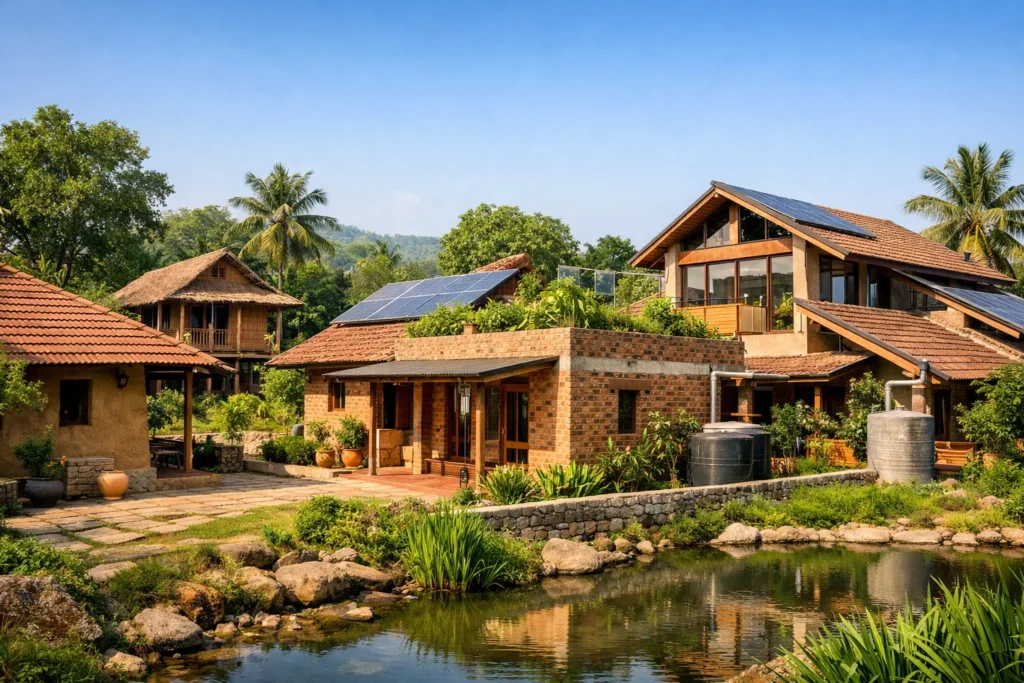
Have you ever stared at your house and wondered, “Can my home stop wasting energy, cut bills, and actually help the planet?” I asked that question the first time I saw a mud-brick wall that stayed cool through a 40°C day — and that curiosity led me to study real eco-homes across India that prove low-impact living works.
Why this matters — quick facts you should know ⭐
The building sector uses a large share of India’s electricity — roughly one-third of the country’s power.
India is rapidly adding solar capacity: grid-connected rooftop solar has grown strongly and national solar capacity exceeded 130 GW in 2025.
India has thousands of registered green building projects and multiple certification systems (IGBC, LEED, GRIHA) promoting low-energy design.
These facts explain why homeowners, architects, and policymakers focus on eco-friendly homes: they save money, lower emissions, and increase comfort.
What makes a home truly eco-friendly? 👤
Passive design (orientation, cross-ventilation, shading).
Low-embodied-carbon materials (CSEB, fly-ash bricks, bamboo).
Renewable energy (rooftop solar + efficient appliances).
Water systems (rainwater harvesting, greywater reuse).
Waste & landscape (composting, native gardens).
Each item above appears in the 13 homes we explore next.
At a glance — Table of the 13 homes (location + standout features) 📋
| No. | Home | Location | Key eco-features |
|---|---|---|---|
| 1 | Swasya Living | Bangalore area, Karnataka | CSEB, solar, rainwater harvesting |
| 2 | Hombelaku | Bangalore, Karnataka | Mud/clay walls, greywater reuse, solar water heater |
| 3 | Sanjay & Pratibha Singh House | Bangalore | Passive design, organic gardening, greywater reuse |
| 4 | N R House | Hyderabad, Telangana | IGBC/green rating, thermal insulation, solar |
| 5 | Farmer’s Home | Dapoli/Dakivali region, Maharashtra | Fly-ash blocks, central courtyard, passive cooling |
| 6 | Hosamane | Bangalore | Off-grid solar, composting toilets, rooftop garden |
| 7 | Coconut Shells House | Mumbai | Recycled coconut shell insulation, vertical garden |
| 8 | 100% Recyclable House | Anangpur, Haryana | Bottle & tyre reuse, earth-bermed design |
| 9 | Kerala Eco-House | Kottayam, Kerala | Rainwater filtration, wind tower, exposed brick |
| 10 | Laurie Baker Inspired Home | Trivandrum, Kerala | Rat-trap bond, sloping roofs, low cost |
| 11 | Nature-Integrated Home | Guwahati, Assam | Hill-sensitive design, permeable paths, solar |
| 12 | Aangan | Ahmedabad, Gujarat | Shaded courtyards, passive cooling, recycled materials |
| 13 | Forest Retreat | Near Garbhanga Forest, Assam | Bamboo, earth plaster, solar, rainwater harvesting |
Deep dive: the 13 homes — what they teach us
1. Swasya Living — managed farmland close to Bangalore 🌱
Why it’s inspiring: Swasya uses compressed stabilized earth blocks (CSEB) for walls. CSEBs require less firing energy than traditional bricks and often cut embodied carbon by large margins. The site pairs CSEB walls with rooftop solar and rainwater harvesting to serve cottages and small farms. This combination shows how material choice plus renewable energy reduces operational and embodied emissions.
2. Hombelaku — earthen comfort in the city 🏡
Hombelaku uses locally mixed clay blocks and avoids synthetic paints. Designers rely on cross-ventilation, high windows, and shade to maintain comfort. Greywater from sinks feeds a garden. The house proves that simple materials and smart plumbing deliver big comfort gains with small budgets.
3. Sanjay & Pratibha Singh House — passive first, tech second 🌿
This home focuses on passive cooling: tall windows, shaded courtyards, and a layout that moves heat away from living spaces. Solar panels reduce grid draw; a kitchen garden uses greywater. Their approach is low-tech, resilient, and repeatable in many Indian cities.
4. N R House, Hyderabad — certified performance ✅
N R House demonstrates how thermal insulation, solar PV, and water capture work together in a modern urban home. It earned a high green-rating and shows that certified design can drive measurable savings in energy and indoor comfort.
5. Farmer’s Home, Dakivali — rural, low-cost, high function 🚜
Built with fly-ash jaali blocks and local stone, this home uses a central aangan (courtyard) to cool interiors naturally. Fly-ash bricks reduce construction emissions and save topsoil. The design illustrates cost-effective rural sustainability.
6. Hosamane — self-sufficient suburban model ☀️
Hosamane runs primarily on solar with battery backup, collects rainwater in tanks, and recycles greywater for irrigation. Composting toilets and a rooftop vegetable patch minimize waste and dependency on municipal services.
7. Coconut Shells House, Mumbai — creative recycling 🥥
This micro-home uses discarded coconut shells as a low-cost insulation layer. The shells create tiny air pockets that lower indoor temperatures. The project demonstrates how local waste streams can become building assets.
8. 100% Recyclable House, Haryana — full-cycle reuse 🔁
Built from bottles, scrap metal, and tyres, this house shows that even structural parts can use reused materials safely with thoughtful engineering. An earth-bermed layout stabilizes temperatures.
9. Kerala Eco-House — tradition plus modern systems 🌀
Embracing exposed brick, sloping roofs, and wind towers, this home uses rainwater systems and passive ventilation to cut energy needs. Kerala’s climate rewards designs that draw on local wisdom.
10. Laurie Baker Inspired House, Trivandrum — low cost, high value 🧱
Following Laurie Baker’s techniques (rat-trap bond masonry, jali walls), this home reduces material use and boosts comfort with minimal mechanical systems.
11. Nature-Integrated Home, Guwahati — slope-sensitive design 🌄
On a hillside, the house nestles into the slope rather than flattening it. Permeable paths and native planting reduce storm runoff; solar and greywater systems keep resource use lean.
12. Aangan, Ahmedabad — courtyard living for hot climates ☀️
Aangan places shaded courtyards and courtyards to cool internal rooms naturally. Combined with solar readiness and recycled finishes, it reduces both energy use and embodied carbon.
13. Forest Retreat, Assam — bamboo and biodiversity 🌳
The Forest Retreat uses bamboo framing and earth plasters. Native landscaping and a living roof create habitat for insects and birds while insulating the home.
Materials table — quick guide for builders (uses, benefits, cautions) 📋
| Material | Why use it | Benefit | Caution / Where it works best |
|---|---|---|---|
| CSEB (Compressed earth) | Local soil + small stabilizer | Lower embodied CO₂; thermal mass keeps interiors cool. | Needs good drainage and proper curing in wet climates. |
| Fly-ash bricks | Industrial by-product | Avoids topsoil loss; lighter; often lower embodied energy. | Quality varies; follow standards and sourcing rules. |
| Bamboo | Fast-growing, renewable | High strength-to-weight; low embodied carbon | Needs proper treatment for durability. |
| Rammed earth | Compacted layers of soil | Great thermal performance | Sensitive to prolonged wetting unless sealed. |
| Recycled materials | Bottles, tyres, shells | Cuts waste and embodied carbon | Engineering must ensure safety and insulation. |
(Studies show CSEB and fly-ash options reduce carbon compared to fired bricks in many cases).
Energy, water, and money — real benefits with facts 🔎
Energy use: Buildings account for a significant share of electricity demand in India — acting on building design therefore reduces national electricity growth.
Solar impact: Growing rooftop solar reduces household grid bills and lowers reliance on fossil-fuel power during peak hours; India’s solar capacity crossed 130 GW by late 2025.
Materials: Switching from fired clay bricks to CSEB or fly-ash bricks can lower embodied CO₂ and preserve topsoil; CSEB can reduce CO₂ emissions by multiple times compared with fired bricks.
Those facts make the case: design choices save operational energy and cut construction emissions.
How to plan an eco home — a practical, step-by-step checklist ⭐
Site first: Note sun path, prevailing winds, and slope. Orient living spaces for daylight and cooling.
Passive design: Use overhangs, courtyards, and cross-ventilation to lower mechanical cooling need.
Choose materials: Prioritize local, low-embodied-energy materials (CSEB, fly-ash, bamboo).
Install renewables early: Add solar PV and solar water heating during construction to reduce retrofit costs.
Water systems: Fit rainwater harvesting and plan greywater reuse for gardens. (National guidelines encourage adoption.)
Landscape for microclimate: Use native trees and permeable surfaces to cool and recharge groundwater.
Certify if possible: Use IGBC, GRIHA, or other standards to track performance and resale value.
Small retrofits that deliver big returns
Add LED lighting and star-rated appliances.
Fit solar water heaters — they cut LPG/electric hot water use.
Collect rooftop water in tanks for irrigation.
Improve shading (awnings, trellises) and add reflective terrace paint to reduce heat gain.
Replace a portion of clay bricks with fly-ash bricks on repairs/extension projects.
Policy & certification — where incentives exist 💡
India supports renewables and green building uptake through incentives and rules. Rooftop solar schemes and state-level subsidies lower upfront cost; national policies promote rainwater harvesting and fly-ash use near thermal plants. Certification bodies like IGBC and LEED offer measurable standards that buyers and lenders increasingly respect.
Quick comparison — payback & impact 📊
| Intervention | Typical upfront cost* | Primary benefit | Notes |
|---|---|---|---|
| Rooftop solar PV | Medium–high | Cuts electricity bills, fast payback in high-tariff areas. | Incentives vary by state. |
| Solar water heater | Low–medium | Cuts gas/electric water heating | Simple tech; quick payback. |
| Rainwater harvesting | Low | Water security, reduced municipal bills. | Maintains groundwater if designed right. |
| CSEB walls | Low–medium | Lower embodied CO₂; good thermal mass. | Needs skilled masonry. |
| Fly-ash bricks | Low | Reduce topsoil use; lighter walls. | Use certified suppliers. |
*Costs depend on region and scale; this table outlines typical relationships, not exact prices.
Design rules that work in Indian climates
Hot-dry zones: Orient for maximum shading; use courtyards and high thermal mass walls.
Humid tropics: Maximize cross-ventilation and keep roofs ventilated; avoid heavy sealed glazing.
Cold highlands: Insulate walls and roofs; add compact glazing to capture sun.
Local climate determines the best mix of passive, material, and mechanical solutions.
How these homes affect health & resale value — evidence, not opinion
Health: Low-VOC materials and natural ventilation reduce indoor pollutants and respiratory stress. Several case studies link improved indoor air to fewer sick days. (See green building guidance by certification bodies.)
Resale value: Certified green projects show higher buyer interest in urban markets; LEED/IGBC numbers report steady certification demand.
Practical resources & next steps
IGBC — green rating systems and project database.
MNRE — rooftop solar and subsidy programs.
Local building code / National Building Code for rainwater harvesting: follow municipal rules and NBC guidelines.
If you want a quick consultation or references to certified green architects, check a specialist like akronroofingexperts.com for roofing-related retrofit options and water-proofing that complement green roofs and solar installs.
Final thoughts — short and practical 🎯
Eco-friendly homes in India prove you can cut emissions, lower bills, and improve comfort using local materials, passive design, and renewables. The 13 examples above show a spectrum: from ultra-low-cost earthen homes to modern, certified green houses. Start with site-sensitive design, use local materials, and add solar and water systems early to lock in savings.